
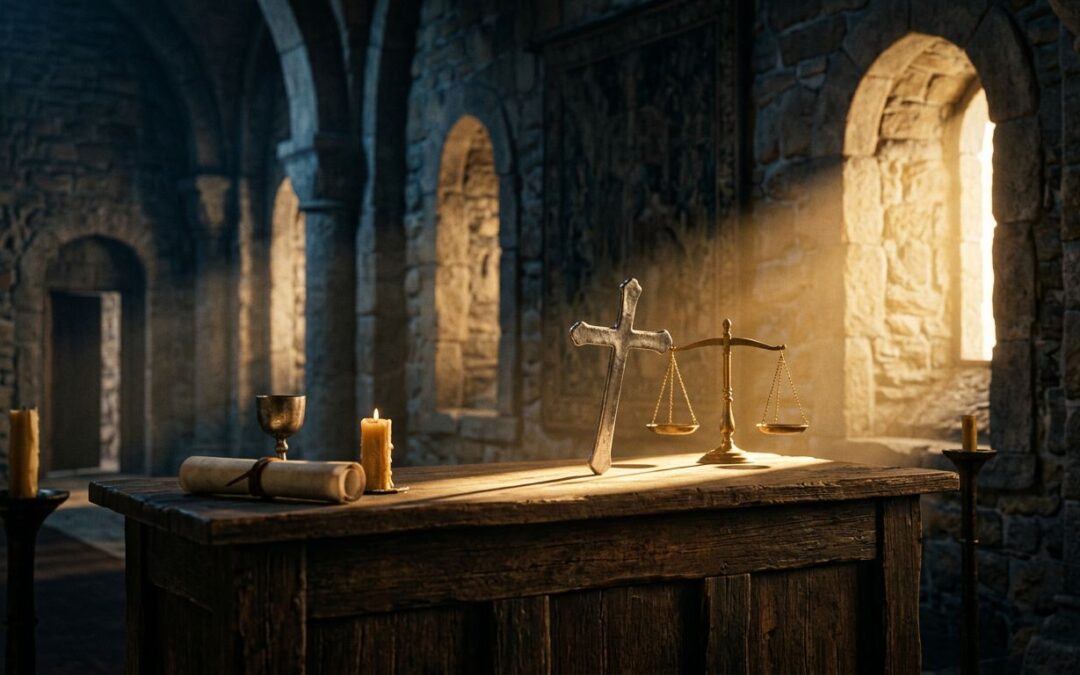
We all want justice until justice turns and looks at us. When evil seems to win, we ask whether God sees, whether God cares, and whether God will act. Developing a proper biblical understanding helps us navigate these difficult questions.
The Bible answers with a clear yes. God’s justice is not a harsh streak in His nature. It is the expression of His holiness and goodness dealing rightly with every person, every sin, and every promise. If we want to know God as He is, we have to start there.
Key Takeaways
- God’s Nature: Justice is not merely an action God takes, but an essential attribute rooted in His holy and unchanging character; He is the perfect Judge who never misreads the facts or calls evil good.
- Beyond Punishment: Biblical justice extends beyond judgment to include active protection for the oppressed, honest dealings in daily life, and the pursuit of right order in the marketplace and the home.
- The Cross as the Solution: The cross of Christ resolves the tension between God’s demand for justice and His offer of mercy, as Jesus served as the atoning sacrifice that satisfies the penalty of sin while enabling forgiveness for the guilty.
- Call to Obedience: Living under God’s justice requires believers to reflect His character through integrity, impartiality, and the defense of the vulnerable, rather than taking vengeance or using justice as a public image tactic.
God’s justice is rooted in who He is
The Bible does not treat justice as one choice among many that God might make. Instead, Scripture identifies justice as an essential attribute of God that defines His character. In Deuteronomy 32:4, Moses calls Him the Rock and says, “all his ways are justice.” Moses spoke those words after years of Israel’s rebellion in the wilderness. He had seen human failure up close, yet he declared that God never does wrong.
That matters because we often measure justice by outcomes we can see, whereas God measures it by His own righteous nature. While humans created in the image of God struggle with limited perspective, He never bends because of pressure. He never misreads the facts, He never punishes the innocent, and He never calls evil good.
Abraham leaned on this truth when he spoke to God about Sodom. In Genesis 18:25 he asked, “Shall not the Judge of all the earth do what is just?” Abraham was not correcting God; he was appealing to what God always is. The Judge of all the earth does right because He cannot do otherwise.
“Righteousness and justice are the foundation of your throne” (Psalm 89:14).
That verse tells us something weighty. Justice is not a side issue in God’s rule, as it serves as the foundation of his throne. A human court can be bribed, rushed, confused, or corrupted, but God’s court cannot. A helpful companion to these texts is this explanation of God as a God of justice, which traces the same biblical point.
So when we speak about God’s justice, we are not speaking about divine temper; we are speaking about divine perfection. That should steady us, and it should humble us. The God who judges evil also judges us with perfect truth.
Justice in the Bible protects what is right
Many people hear the word justice and think only of punishment. However, biblical justice is far broader than that. It encompasses judgment against evil, but it also reflects true justice through right order, honest dealing, and active protection for the poor and oppressed.
That is why the Old Testament so often joins justice with righteousness. The two belong together. God does not only punish wickedness after the fact. He loves what is straight, clean, and faithful in the present. Isaiah 61:8 says, “For I the Lord love justice.” That comes in a promise of restoration, where God assures His people that His covenant faithfulness has not died.
The prophets made this plain. Amos did not rebuke Israel only for false worship. He rebuked them because their religion was noisy while their public life was rotten. In Amos 5, God rejects their songs and assemblies, then says, “let justice roll down like waters, and righteousness like an ever-flowing stream.” Empty worship could not hide crooked business, the neglect of widows and orphans, or dishonest courts.
Photo by KATRIN BOLOVTSOVA
Micah preached the same truth. In Micah 6:8, the Lord cuts through the noise of empty ritual to call for a life that fits His character: “to do justice, and to love kindness, and to walk humbly with your God.” This teaching mirrors the heart of the Sermon on the Mount, where inward transformation dictates outward action. Justice, then, is not a slogan. It is obedience in the marketplace, in the courtroom, in the home, and in the congregation.
This is why biblical justice never fits neatly into our modern tribes. It is not soft on sin, and it is not hard on the weak. It is morally clean and neighbor-conscious at the same time. A useful summary of that wider pattern appears in Timothy Keller’s piece on justice in the Bible.
When God calls His people to justice, He is not asking for public image repair. He is calling for lives that match His own righteousness.
The cross answers the hardest question
Here is the hardest question in the whole matter: if God is just, how can He forgive sinners like us? If He simply overlooks guilt, justice is gone. If He judges every sin on us, mercy is gone. The Bible does not dodge that tension. It answers it at the cross of Christ.
Romans 3 is one of the clearest places to see it. Paul has already said that Jews and Gentiles alike are under sin. No one can claim innocence before God. Then Paul says God put Jesus Christ forward as the atoning sacrifice to show His righteousness. Why? Because God had passed over former sins in His patience, and the cross would show that He had never become indifferent to evil. Through this sacrifice, God addresses the issue of sin and penalty once and for all.
God is “just and the justifier of the one who has faith in Jesus” (Romans 3:26).
That sentence is the center of the matter. God remains just, and God justifies sinners. He does not do one by canceling the other. He judges sin in Jesus Christ, and He forgives all who trust in Him. Mercy is not God pretending our guilt is small. Mercy is God providing what His justice requires.
Exodus 34 helps us see the same truth in seed form. After Israel worshiped the golden calf, God revealed Himself to Moses as a God of mercy and grace, yet also as the One who will by no means clear the guilty. Those truths are not enemies. They meet at Calvary.
Jesus Himself taught this balance. He welcomed sinners, but He never blessed their sin. He told the woman caught in adultery to go and from now on sin no more. He cleansed the temple because worship had been corrupted. He warned of final judgment because eternity is real. If we want a fuller treatment of this line of thought, this essay on thinking biblically about justice is helpful.
The Gospel tells us that God’s justice is not less than we feared. It is more. It also tells us that God’s mercy is not less than we hoped. It is greater.
Living under God’s justice today
If God’s justice is real, then our lives cannot stay casual about truth, fairness, and mercy. We cannot praise a righteous God and then love partiality, deceit, or revenge. The Bible will not let us split devotion from conduct.
James 2 warns the church against favoritism. Why? Because partiality is a form of injustice that denies the character of the Lord we confess. Proverbs condemns false weights because dishonest gain is never small to God. Romans 12 tells us not to avenge ourselves because final judgment belongs to Him. According to the Revelation given to the church about the end times, Acts 17:31 confirms that God has fixed a day when He will judge the world in righteousness by the risen Christ. This righteous judgment means that no evil finally escapes, even when it avoids earthly courts.
That future accountability gives us both hope and restraint. Hope, because wrong will not rule forever. Restraint, because we are not the final judge. We are called to act justly, speak truthfully, and protect the weak as citizens of the kingdom of God, but we are not called to take His throne.
In ordinary life, practicing God’s justice means simple things that are often hard:
- We tell the truth, even when a lie would protect our image.
- We refuse favoritism, whether the person is rich, powerful, popular, or useful.
- We care about the vulnerable, because biblical justice is never blind to need.
- We leave vengeance to God, while still seeking what is right through lawful and godly means.
This reaches our homes, our work, our church life, and our speech online. It touches how we handle money, how we judge a conflict, and how we treat a person who cannot repay us. Justice is not only for headlines. It is for Tuesday afternoon.
And we must say this plainly: we do not pursue justice as people who think we are better than others. We pursue it as sinners who have received mercy. That same link between justice and neighbor-love is captured well in this reflection on love of neighbor in action.
Frequently Asked Questions
If God is perfectly just, how can He be merciful to sinners?
God remains both just and merciful through the sacrifice of Jesus Christ at the cross. He does not overlook or ignore sin, but rather judges it fully in Christ, allowing Him to forgive those who trust in Him while maintaining His own righteous standards.
Is biblical justice the same as modern social justice movements?
Biblical justice often transcends modern political categories because it is neither soft on sin nor indifferent to the vulnerable. It demands personal holiness and moral integrity while simultaneously commanding active love and protection for the poor and marginalized.
Why does the Bible say we should not seek revenge if God is a God of justice?
Because God is the ultimate, perfect Judge, we are called to practice restraint and trust in His final accounting. Attempting to take vengeance ourselves usurps His role and ignores the fact that He has already promised to judge the world in righteousness.
What does it mean to “do justice” in everyday life?
Doing justice involves living in obedience to God in mundane situations, such as telling the truth when it is inconvenient, refusing to show favoritism to the powerful, and caring for those in need. It is a consistent way of reflecting God’s character in our homes, workplaces, and interactions with our neighbors.
Conclusion
We all want justice until justice turns and looks at us. The Bible says that when it does, we do not meet a crooked judge or a careless ruler. Instead, we meet the holy God whose perfect moral justice sets the standard for everything that is right.
That is why God’s justice is not a threat to His love. It is one of the clearest proofs of His goodness. He hates evil, He defends what is right, and in Christ, He makes a way for guilty people to be forgiven without calling sin good.
When we learn to see justice this way, we stop remaking God in our own image. We bow before Him, trust His judgment, and learn to love what He loves.