
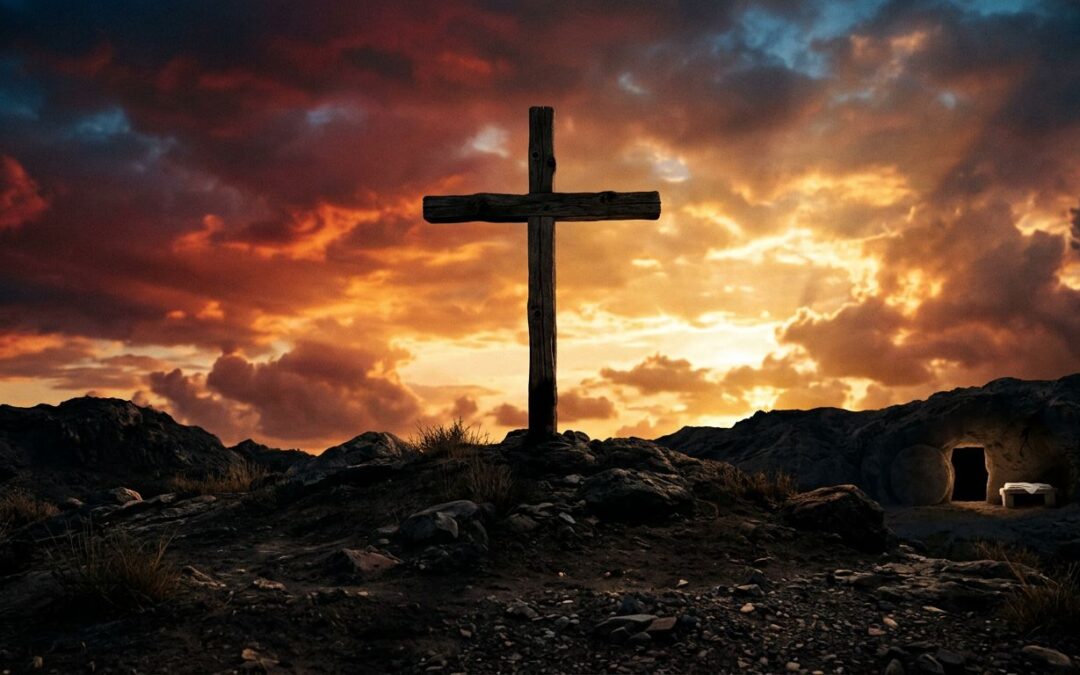
The cross was not an accident, a tragic ending, or a symbol emptied of meaning. Jesus Christ died willingly for sinners, according to the Scriptures, and He rose again in victory. We cannot understand His death rightly if we separate Good Friday from the empty tomb.
The Bible gives more than one faithful way to describe what happened at Calvary. Jesus became the sacrifice for sin, bore judgment in our place, reconciled us to God, defeated the powers of darkness, and revealed the holy love of God. We must hold these truths together because the cross is greater than one explanation alone, and we must explore the biblical meaning of the cross to fully grasp the significance of Calvary.
Key Takeaways
- Jesus' death was planned by God and willingly accepted by the Son.
- The cross addresses the human condition through the sacrifice of Jesus, providing the necessary forgiveness of sins, substitution, reconciliation, and ultimate victory.
- Jesus' resurrection proves that His death accomplished salvation and serves as the ultimate assurance that death could not hold Him.
- The cross serves as a profound display of God's love and holiness, with the resurrection acting as the definitive proof of God's completed work.
- Those who trust Christ receive forgiveness and are called to deny themselves and follow Him.
Jesus Died Willingly for Our Salvation
Jesus did not stumble into the cross without understanding what was coming. He repeatedly told His disciples that He would be rejected, killed, and raised again. Matthew 16:21, Mark 8:31, and Luke 9:22 each record this teaching.
The cross was part of God's saving purpose, yet Jesus was not forced against His will. He said:
"Therefore doth my Father love me, because I lay down my life, that I might take it again. No man taketh it from me, but I lay it down of myself."
John 10:17-18, KJV
That statement corrects two errors. Jesus was not a helpless victim whose life was taken from Him. Neither was the Father an unwilling observer who had to be persuaded to show mercy. The Father gave the Son, and the Son willingly gave Himself.
In Gethsemane, Jesus faced the full weight of the suffering before Him. He prayed, "O my Father, if it be possible, let this cup pass from me: nevertheless not as I will, but as thou wilt" (Matthew 26:39, KJV). His prayer shows real anguish, but it also shows perfect obedience.
We should never treat the cross as a sentimental religious image detached from sin and judgment. Jesus went to this instrument of execution because the problem of human sin is serious. Sin is rebellion against the holy God, not merely a collection of mistakes. We need more than advice, inspiration, or moral improvement. We need forgiveness and reconciliation with God.
Jesus Himself explained His mission in these words:
"For even the Son of man came not to be ministered unto, but to minister, and to give his life a ransom for many."
Mark 10:45, KJV
The word ransom points to the cost of freedom. Through the crucifixion, Christ gave His life as a sacrifice to rescue sinners from their sin and provide eternal salvation for those who could not rescue themselves. A fuller discussion of the Bible's teaching on the significance of His death can be found in this explanation of Jesus Christ's death.
What Jesus’ Death Accomplished
The New Testament provides the essential theological framework for understanding the meaning of the cross. It uses several distinct pictures to explain this mystery, and these are not competing messages. Instead, each one reveals a vital part of the same saving work.
Jesus bore our sins. Peter wrote, "Who his own self bare our sins in his own body on the tree, that we, being dead to sins, should live unto righteousness: by whose stripes ye were healed" (1 Peter 2:24, KJV). Christ did not die for His own sin, as He had none. He bore the sins of others through the logic of substitutionary atonement. Paul wrote, "For he hath made him to be sin for us, who knew no sin; that we might be made the righteousness of God in him" (2 Corinthians 5:21, KJV). This language of substitution means that Jesus took the place of sinners so that those who trust Him could receive a righteous standing before God.
Jesus became the sacrifice for sin. The Old Testament sacrifices taught Israel that sin brings death and that forgiveness requires atonement. While the blood of animals pointed toward cleansing, it could not finally remove sin. Hebrews explains that Christ entered the holy place by His own blood, obtaining eternal redemption for us (Hebrews 9:12, KJV).
Jesus is the ultimate fulfillment of the Passover pattern. In Exodus 12, the blood of the lamb protected Israel from judgment. John the Baptist identified Jesus as the Lamb of God, which taketh away the sin of the world (John 1:29, KJV). The cross is the place where the true Lamb gives Himself for His people.
Jesus satisfied divine justice. Romans 3:25 speaks of Christ as the One whom God set forth to be a propitiation through faith in His blood. Scripture does not present forgiveness as God pretending that sin does not matter. God is merciful, but He is also righteous. At the cross, God remains just while justifying those who believe in Jesus (Romans 3:26).
Jesus achieved our reconciliation. Sin creates hostility between sinners and their Creator. Through Christ, those who were far away are brought near. Paul wrote that God was in Christ, reconciling the world unto Himself, not imputing their trespasses unto them (2 Corinthians 5:19, KJV).
Jesus defeated the powers of darkness. The cross looked like public defeat, but it became the place where Christ disarmed His enemies. Colossians 2:15 says that Jesus spoiled principalities and powers and triumphed over them. Satan, sin, and death do not have the final word over those who belong to Christ.
Some Christians place greater emphasis on substitution, while others emphasize Christ's victory, sacrifice, ransom, reconciliation, or the revelation of God's love. These biblical themes should not be separated into rival theories. The cross is one saving act with several faithful descriptions.
The Cross Must Be Read Through the Resurrection
Jesus' death cannot be understood apart from His resurrection. If Christ remained in the grave, the cross would be a martyr's death, not the finished work of redemption. Paul stated the gospel plainly:
"For I delivered unto you first of all that which I also received, how that Christ died for our sins according to the scriptures; and that he was buried, and that he rose again the third day according to the scriptures."
1 Corinthians 15:3-4, KJV
The resurrection confirms who Jesus is. It confirms that the Father accepted His sacrifice. It confirms that death could not keep the sinless Son in the grave. Peter preached that God raised Jesus up, "having loosed the pains of death: because it was not possible that he should be holden of it" (Acts 2:24, KJV).
The resurrection also confirms that believers have a living Savior. We are not trusting a dead teacher whose ideas survived Him. We trust Jesus Christ, who was crucified, buried, raised, and exalted at the right hand of the Father.
That truth changes how we speak about the cross. We do not say that Jesus died only to give us an example of courage. We do not say that the resurrection was a comforting story added later. The apostles preached the death and resurrection together as the center of the gospel, showcasing the power of God to overcome the finality of death.
The cross shows the cost of salvation. The empty tomb confirms that salvation has been accomplished through the sacrifice of Jesus Christ. The cross deals with guilt, while the resurrection declares His victory over the grave. The cross brings forgiveness, and the resurrection gives new life and the hope of our own bodily resurrection (Romans 6:4; 1 Corinthians 15:20-23).
The meaning of the cross includes suffering, but it never ends in suffering. As a helpful comparison of the cross's many biblical meanings puts it, Christian faith sees death and resurrection together rather than treating the crucifixion as an isolated event. We can consider those themes in this discussion of Jesus' death and the cross.
The Cross Reveals God’s Holiness and Love
The cross tells us what God is like. It reveals His holiness and justice because God does not ignore sin. It reveals God's love because He does not abandon sinners to the judgment they deserve.
Romans 5:8 says, "But God commendeth his love toward us, in that, while we were yet sinners, Christ died for us" (KJV). God did not wait until we became worthy. Christ died for us while we were still sinners.
This is not a weak love that excuses evil. Biblical love does not call darkness light. God's love sends the Son to save people from sin, not to assure them that sin is harmless. The same cross that displays mercy also declares that rebellion against God is deadly.
We must also reject the idea that the Father cruelly punished an unwilling Jesus. The Father and the Son are not divided in purpose. Jesus said, "I and my Father are one" (John 10:30, KJV). The Son willingly obeyed the Father, and the Father willingly gave the Son for the salvation of the world (John 3:16).
The cross shows the unity of divine holiness, justice, mercy, and love. We cannot reduce God to kindness without truth, or truth without mercy. At Calvary, God does not set His character aside. He reveals it.
This is why the cross brings assurance to the believer. Our confidence is not based on our changing emotions or our record of good works. It rests on the finished work of Christ. Jesus cried, "It is finished" (John 19:30, KJV), and our faith in that work of salvation provides the certainty that His sacrifice was accepted.
The Old Testament Points Toward Jesus’ Death
The Bible does not introduce the cross as a surprise disconnected from the history that came before. Instead, the Old Testament prepares us to understand the purpose of Jesus through promises, sacrifices, patterns, and prophecies. These scriptural foundations provide the necessary context for the atonement Jesus would ultimately achieve.
Isaiah 53 serves as one of the clearest prophetic passages regarding the suffering Servant. It foretells the death of the Messiah, noting:
"But he was wounded for our transgressions, he was bruised for our iniquities: the chastisement of our peace was upon him; and with his stripes we are healed."
Isaiah 53:5, KJV
The chapter continues by stating, "The LORD hath laid on him the iniquity of us all" (Isaiah 53:6, KJV). The Servant suffers and experiences death for the guilty. He is rejected, wounded, oppressed, and killed, yet His willing sacrifice brings justification to many.
Psalm 22 offers another striking picture. It begins with the cry, "My God, my God, why hast thou forsaken me?" (Psalm 22:1, KJV), which are the exact words Jesus spoke from the cross in Matthew 27:46. The psalm describes mockers, pierced hands and feet, divided garments, and public shame. It also ends in praise and worldwide proclamation, reminding us that suffering does not have the final word.
Jesus also connected His impending death to the bronze serpent in Numbers 21. When Moses lifted the serpent in the wilderness, the people who looked upon it lived. Jesus applied this to Himself, saying, "As Moses lifted up the serpent in the wilderness, even so must the Son of man be lifted up" (John 3:14, KJV). Today, those who look to Christ in faith receive the eternal life secured by His sacrifice.
The Passover lamb, the various Old Testament sacrifices, the suffering Servant, the righteous sufferer in the Psalms, and the lifted serpent all point toward Jesus. None of these images individually exhausts the meaning of the cross. Together, they teach us to see His death as the ultimate act of atonement, providing rescue, judgment, healing, and a new covenant.
Jesus explicitly taught that Moses, the Prophets, and the Scriptures spoke about Him (Luke 24:27, 44-47). The cross is not an isolated doctrine; it is the center toward which the entire biblical story moves.
What the Cross Means for Those Who Believe
The cross calls for a response. We cannot admire it from a distance while remaining unchanged. The gospel announces what Christ has done, and faith receives Him as Savior and Lord.
First, we must repent. Repentance is not mere regret. It is a turning away from sin and a turning toward God. Jesus died to free us from sin's guilt and power, not to give us permission to remain in rebellion. Paul asked, "Shall we continue in sin, that grace may abound?" His answer was direct: "God forbid" (Romans 6:1-2, KJV). True faith in Jesus as our mediator leads to the forgiveness of sins and the gift of eternal life.
Second, we must believe in Jesus Christ. Salvation is not earned through religious performance. We are justified by faith in Christ, who died and rose again (Romans 10:9-10; Ephesians 2:8-9). We trust His finished work rather than our own goodness.
Third, we must identify with Christ in daily obedience. Jesus said:
"If any man will come after me, let him deny himself, and take up his cross daily, and follow me."
Luke 9:23, KJV
Our cross-bearing does not add to Jesus' atoning sacrifice. His death is unique, complete, and never repeated. We do not save ourselves by suffering. We follow the Savior who has already given Himself for us.
To take up their cross means that followers of Jesus acknowledge His authority over their choices, plans, bodies, relationships, and possessions. It means we refuse to make self the ruler of our lives as we seek to live within the kingdom of God. Sometimes obedience costs comfort, reputation, money, opportunity, or safety. The call is still the same: deny ourselves and follow Jesus.
Paul wrote, "God forbid that I should glory, save in the cross of our Lord Jesus Christ" (Galatians 6:14, KJV). We do not boast in personal morality, religious status, or human achievement. We glory in Christ crucified and risen.
If you are asking what it means that Jesus died for sin, the answer is not that salvation is automatic apart from faith. The Bible calls us to trust Christ, confess Him, repent, and continue in faithful obedience. This explanation of Jesus dying for our sins also points readers toward that central biblical claim.
The Cross Is More Than a Religious Symbol
A cross worn around the neck or placed in a church building can remind us of Christ, but the object itself has no power to save. While it is a common symbol of Christianity, we must remember that the true power lies in the crucified and risen Jesus. We must never substitute a symbol for faith.
The cross is also more than an example of human suffering or a mere moral model. Jesus did show courage, humility, forgiveness, and obedience at Calvary, but the New Testament does not teach that He died only to inspire us to behave better. The meaning of the cross is found in the reality that He died for sins, in the place of sinners, to bring us to God.
The cross is not proof that God approves every human choice. It is proof that God takes sin seriously and provides mercy through Christ. It does not teach us to make peace with sin; it teaches us to be reconciled to God and to walk in newness of life.
Neither should we choose between the cross and the resurrection. We need both. A cross without the resurrection leaves us with a dead Messiah, while a resurrection without the cross leaves us without the biblical explanation for forgiveness. The apostles preached Jesus Christ crucified and raised.
The meaning of the cross is therefore personal and public. It answers our guilt before God, defeats the enemy, and establishes the new covenant through His sin-bearing work. This reality calls for a response of faith, forming a people who live under Christ's lordship. The cross reaches into every part of Christian discipleship because it tells us who saved us and who now owns our lives.
Frequently Asked Questions
Why did Jesus have to die on a cross?
Jesus died to address the serious problem of human sin, which acts as a barrier between a holy God and humanity. As the perfect sacrifice, He bore the judgment and penalty that our sins deserved, providing the only way for us to be reconciled and forgiven.
Is the cross only a symbol of suffering?
No, the cross is far more than a symbol of suffering or a mere moral example for us to follow. It was a decisive, substitutionary act of redemption where Christ triumphed over the powers of darkness and satisfied divine justice.
Can we understand the meaning of the cross without the resurrection?
The resurrection is essential because it confirms that Jesus’ sacrifice was accepted and that He truly conquered death. Without the empty tomb, the cross would be the end of a martyr’s life rather than the successful completion of our salvation.
How does the death of Jesus change my life today?
Trusting in Christ’s finished work provides you with forgiveness and a new standing before God. It calls you to deny yourself, take up your cross, and follow Him in daily obedience as you live under His authority.
Conclusion
The death of Jesus was willing, substitutionary, sacrificial, victorious, and full of divine love. The Father gave the Son, the Son gave Himself, and the Spirit applies that gift of salvation to those who believe. Scripture provides several layers of truth regarding the meaning of the cross, and these descriptions work in harmony to reveal the fullness of the gospel.
The resurrection serves as the necessary light by which we understand Calvary. Because Jesus Christ did not remain under the power of death, we can be certain that His finished work provides forgiveness for sinners, peace with God, power for daily obedience, and hope beyond the grave. Victory over the grave is the final word of the gospel message.
We do not glory in the cross as a mere religious emblem. Instead, we glory in Jesus Christ crucified and risen, and we follow Him with repentant hearts, steadfast faith, and willing obedience.