
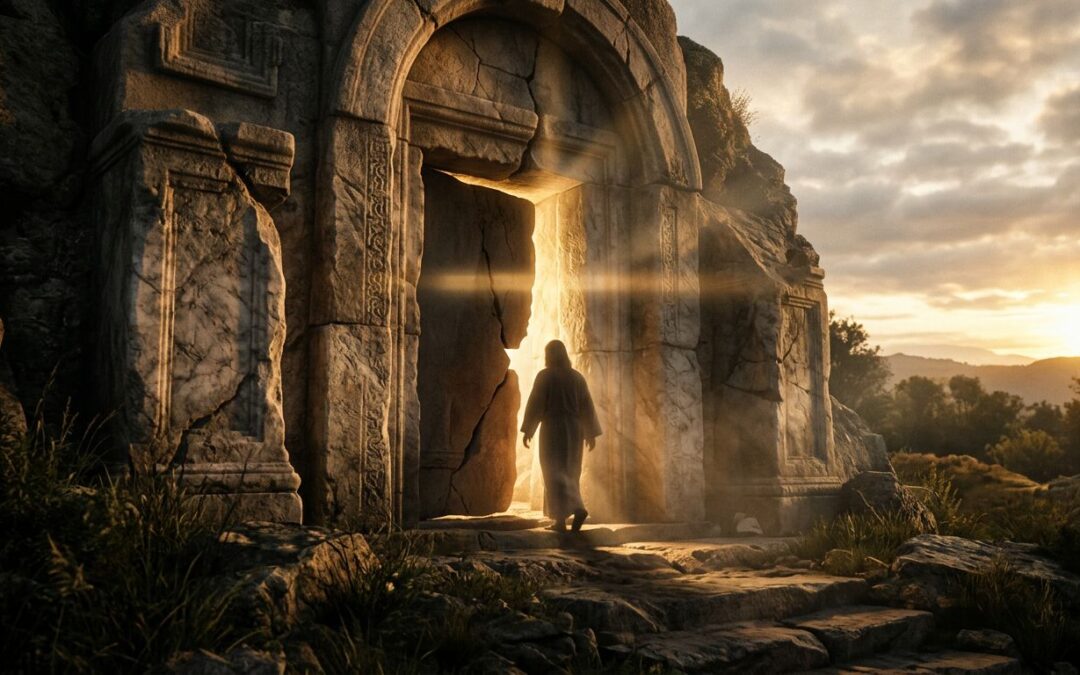
The Bible does not treat the resurrection of the dead as a side doctrine. It puts it near the center of Christian hope, Christian warning, and Christian confidence in Jesus Christ.
Many people think the Christian hope ends when the soul leaves the body. Scripture says more than that, and it says it plainly. We are promised not only life after death, but the raising of the body, the judgment of God, and eternal life in Christ.
The Promise Is Not Symbolic
When Scripture speaks of resurrection, it means waking from death, not a poetic idea about memory or influence. Daniel 12:2 says, “many of those who sleep in the dust of the earth shall awake,” and that line sits in a context of final deliverance and final judgment. It is not talking about a mood, a legacy, or a metaphor. It is talking about God calling the dead back to life.
Job speaks the same way in the middle of his suffering. He says, “after my skin has been thus destroyed, yet in my flesh I shall see God” (Job 19:26). Job is not describing wishful thinking. He is confessing that God will not leave him in the grave forever.
“The dead in Christ will rise first” (1 Thessalonians 4:16)
Even the Old Testament uses images that point in this direction. Ezekiel 37, with the valley of dry bones, first speaks about Israel’s restoration from exile. It is not a direct proof text for the last day, but it does show that God has power over what looks lost. The clearer passages go further and speak of actual resurrection.

The Bible Means a Bodily Resurrection
We need to be clear here, because this point gets blurred often. The Bible does not teach that the body is thrown away while some better, invisible part of us keeps going forever. The Bible teaches bodily resurrection. God redeems the whole person.
Paul says this with great force in 1 Corinthians 15. If Christ has not been raised, our faith is empty. If Christ has been raised, then resurrection is not theory. It is fact. Paul calls Christ “the firstfruits” of those who have fallen asleep, which means his resurrection is the beginning of a larger harvest. What happened to him will happen to his people.
The same chapter also shows that the risen body is not a simple return to the old life. Paul uses the seed and plant picture. A seed is buried, and what comes up is transformed. It is not a different person, and it is not a different story. It is the same life, raised in glory.
That is why we should reject common misunderstandings.
- Not reincarnation. Scripture does not teach repeated lives. It teaches one life, death, judgment, and resurrection.
- Not a ghostly afterlife as the final hope. The final hope is embodied life before God.
- Not a mere symbol for influence or memory. Jesus spoke of tombs, voices, and waking.
Jesus himself guards this truth in Luke 24. After his resurrection, he says, “a spirit does not have flesh and bones as you see that I have.” He eats food in front of his disciples. He shows his wounds. He is recognizable, yet glorified. That is the pattern. Resurrection is not a denial of the body. It is the victory of God over death in the body.
Jesus Rose First, and That Changes Everything
If we miss the resurrection of Jesus, we miss the Christian message. Paul does not treat Christ’s rising as one doctrine among many. He makes it the cornerstone. In 1 Corinthians 15, he says that if Christ is not raised, the apostles are false witnesses, sin still rules, and believers are still in their sins. That is strong language, and it is meant to be.
Christ’s resurrection is historical and personal. It happened to a real body in a real tomb on a real morning. It also carries promise. Because Jesus rose, the tomb will not keep his people forever.
His resurrection also tells us what kind of body the saints will have. Philippians 3:20-21 says the Lord Jesus Christ “will transform our lowly body to be like his glorious body.” That does not mean we become less human. It means we become fully redeemed human beings, freed from decay, weakness, and death.
The risen Christ is not Lazarus all over again. Lazarus returned to mortal life and later died again. Jesus rose never to die again. That difference matters. His resurrection is not a temporary rescue. It is the start of the new creation.
Resurrection, Judgment, and Eternal Life
The Bible never separates resurrection from judgment for long. Jesus says in John 5:28-29 that “all who are in the tombs will hear his voice and come out,” some to the resurrection of life and some to the resurrection of judgment. That is one of the clearest passages we have. Jesus does not offer a vague hope. He speaks of a coming hour, a divine voice, and two outcomes.
Acts 24:15 says the same thing in apostolic preaching, that there will be “a resurrection of both the just and the unjust.” We cannot soften that. The righteous rise to life. The unrighteous rise to judgment. The Bible joins resurrection and accountability because God judges in truth.
Revelation 20 adds more detail, and Christians have differed on the exact order of events there. Some place the millennium in different ways, and we should admit that those questions exist. But the chapter does not leave room for denying final judgment. The dead stand before God, and books are opened. The picture is serious, plain, and unavoidable.
We also need to speak carefully about eternal life. Eternal life is not simply unending existence. Every human soul will not vanish, and every person will not be erased. Eternal life means life in fellowship with God, under the reign of Christ, free from sin and death. It is life as God meant it to be.
That is why the resurrection matters so much. If the body rises, then judgment is real. If judgment is real, then holiness matters. If holiness matters, then our present life is not empty. We belong to Christ in body and soul, and we will answer to him.
Hope for Grief and Holiness
Paul speaks to grieving believers in 1 Thessalonians 4, and he does not tell them to pretend sorrow is not real. He says, “we do not want you to be uninformed, brothers, about those who are asleep, that you may not grieve as others do who have no hope.” That sentence is balanced and strong. We grieve. We also hope.
The hope is not that death is harmless. Death is still an enemy. The hope is that death is not final. The body in the grave is not abandoned by God. The Lord who made the body, and the Lord who redeemed the body in Christ, will raise it in due time.
This changes how we face funerals. It changes how we speak over the dead in Christ. It changes how we comfort one another. We are not standing before a closed door with no key. We are waiting for the voice of Christ.
It also changes how we live now. If the body will rise, then the body matters. What we do with our hands, our eyes, our mouths, and our habits matters. The resurrection is not a reason for laziness. It is a call to steady obedience.
Paul ends 1 Corinthians 15 with this kind of pressure: “be steadfast, immovable, always abounding in the work of the Lord, knowing that in the Lord your labor is not in vain.” That is resurrection living. We do not serve for nothing. We do not suffer for nothing. We do not bury the saints for nothing.
Conclusion
The Bible’s teaching is firm. The resurrection of the dead is bodily, certain, and bound to the voice of Jesus Christ. It is not reincarnation, and it is not a vague spiritual survival. It is God raising the dead, giving life to his people, and bringing every person to judgment.
That is why the empty tomb matters. That is why Paul’s words matter. That is why the grave does not get the last word.
Christ is risen, and because he is risen, the dead will rise.