
Ezra teaches that God faithfully brought Jewish exiles back from the Babylonian exile, but returning to Jerusalem didn't remove their responsibility to obey Him. Restoration required a response: worship had to be restored, God's Word had to be heard, and sin had to be confronted.
When we study Ezra's return, we must distinguish the rebuilding of a city from the surrender of a people. The history begins with God's mercy and covenant, which call His people back under His authority.
Key Takeaways
- Zerubbabel, Ezra, and Nehemiah led distinct stages of return, traditionally dated around 537, 458, and 445 BC.
- The temple was completed before Ezra arrived; Nehemiah later rebuilt Jerusalem's walls.
- God's faithfulness preserved His people, but restored worship didn't eliminate their need for repentance and obedient hearts.
The Three Returns from Exile
These three stages show the restoration in sequence and keep each leader's assignment clear.
1. Zerubbabel: Returning to Rebuild, About 537 BC
Cyrus of Persia conquered Babylon in 539 BC and permitted the Judean exiles to return about one year later, in 538 BC. The first major group reached Jerusalem around 537 BC under Zerubbabel, with Jeshua as the leading priest.
The recorded assembly numbered 42,360, besides 7,337 servants and 200 male and female singers. Their task centered on restoring worship and rebuilding the temple.

2. Ezra: Returning to Teach, About 458 BC
Ezra came from Babylon under Artaxerxes, a king of Persia, as a priest and scribe. His group is commonly counted at about 1,754 men, including the Levites and temple servants recruited for the journey. Women and children accompanied them, but the account doesn't provide a complete population total.
Ezra's assignment concerned the Law of God and the life of the community. The temple already stood, but the people's conduct still required correction.
3. Nehemiah: Returning to Rebuild the Walls, About 445 BC
Nehemiah came as governor with royal authorization to rebuild Jerusalem's defenses. The city's walls were completed in 52 days, despite threats and opposition. Scripture doesn't give his arrival a population total comparable to the earlier groups.
Cyrus's decree opened the way for Jewish exiles to return to Judea, the region also known as Judah, but the community remained under Persian rule.
What the Returnee Numbers Mean
The Assembly Was More Than a List of Men
The first return's total describes the whole assembly. We shouldn't automatically turn 42,360 into a count of adult men and multiply it to produce a larger population.
The named family and community entries don't add neatly to the stated total. The text doesn't explain every difference, so we shouldn't supply an explanation and present it as Scripture.
The additional servants and singers bring the explicitly stated combined figure to 49,897. These categories must remain distinct if we're going to handle the numbers faithfully.
Worship Required People and Provision
The lists identify priests, Levites, singers, gatekeepers, and temple servants. Priests receive their own listings; their responsibilities weren't interchangeable with those of every other servant.
Family leaders also gave toward rebuilding. Their gifts totaled 61,000 gold darics, 5,000 minas of silver, and 100 priestly garments. The silver is sometimes expressed as approximately 6,250 pounds, though modern conversions vary.
These details show us a community preparing for worship through actual service and actual provision. Ezra's account of the returning community gives attention to people, responsibilities, and resources because rebuilding required more than enthusiasm.
God's work called for willing participation.
The Temple Came Before the Walls
The returnees first rebuilt the altar and resumed sacrifices. Work on the temple began around 537 or 536 BC, but opposition discouraged the builders and halted the temple project.
The work remained stalled for roughly sixteen years. Then the prophets Haggai and Zechariah spoke God's Word to the people, and rebuilding resumed in 520 BC under Zerubbabel and Jeshua, also called Joshua.
We must hear the correction in that history. Opposition was real, but the people also needed to confront their own neglected priorities. Our study of the Minor Prophets' historical setting places their preaching within this rebuilding period.
The temple was completed in 516 BC under Darius. Its dedication and the celebration of Passover showed that the restoration of worship followed judgment and displacement.
About seventy years separated the temple's destruction around 586 BC and its completion. That doesn't mean every captive spent an identical seventy years away.
God kept His word through the waiting. Delay didn't release His people from obedience.
Why Ezra’s Arrival Date Is Debated
Ezra records his arrival in the seventh year of Artaxerxes. Nehemiah places his commission in that king's twentieth year.
The traditional identification is Artaxerxes I. This gives us Ezra's arrival in 458 BC and Nehemiah's in 445 BC, a thirteen-year interval.
A study of Ezra's chronology identifies 458 BC and 398 BC as the principal competing dates. The later date places Ezra under Artaxerxes II.
That proposal appeared in 1890 and would put Ezra after Nehemiah. It hasn't displaced the traditional chronology. Another proposal reads the seventh year as the thirty-seventh and places Ezra around 428 BC, but that reading hasn't gained broad support.
On the traditional chronology, Ezra-Nehemiah covers events beginning with Babylon's fall in 539 BC and extending into the second half of the fifth century BC.
The disagreement concerns historical placement, not permission to disregard the account's spiritual instruction.
Ezra Restored Attention to God’s Word
The Teacher Had to Obey
Ezra prepared himself to study the Law of Moses, practice it, and teach it. That order matters. Knowledge didn't exempt the teacher from submission to the God whose Word he explained.
Ezra also sought God through fasting before the journey. His confidence rested in God's protecting hand, not his own ability to organize a successful return.
This remains a necessary correction for ministry. We can't faithfully teach surrender while refusing surrender ourselves. Biblical knowledge carries responsibility before God.
The People Had to Understand
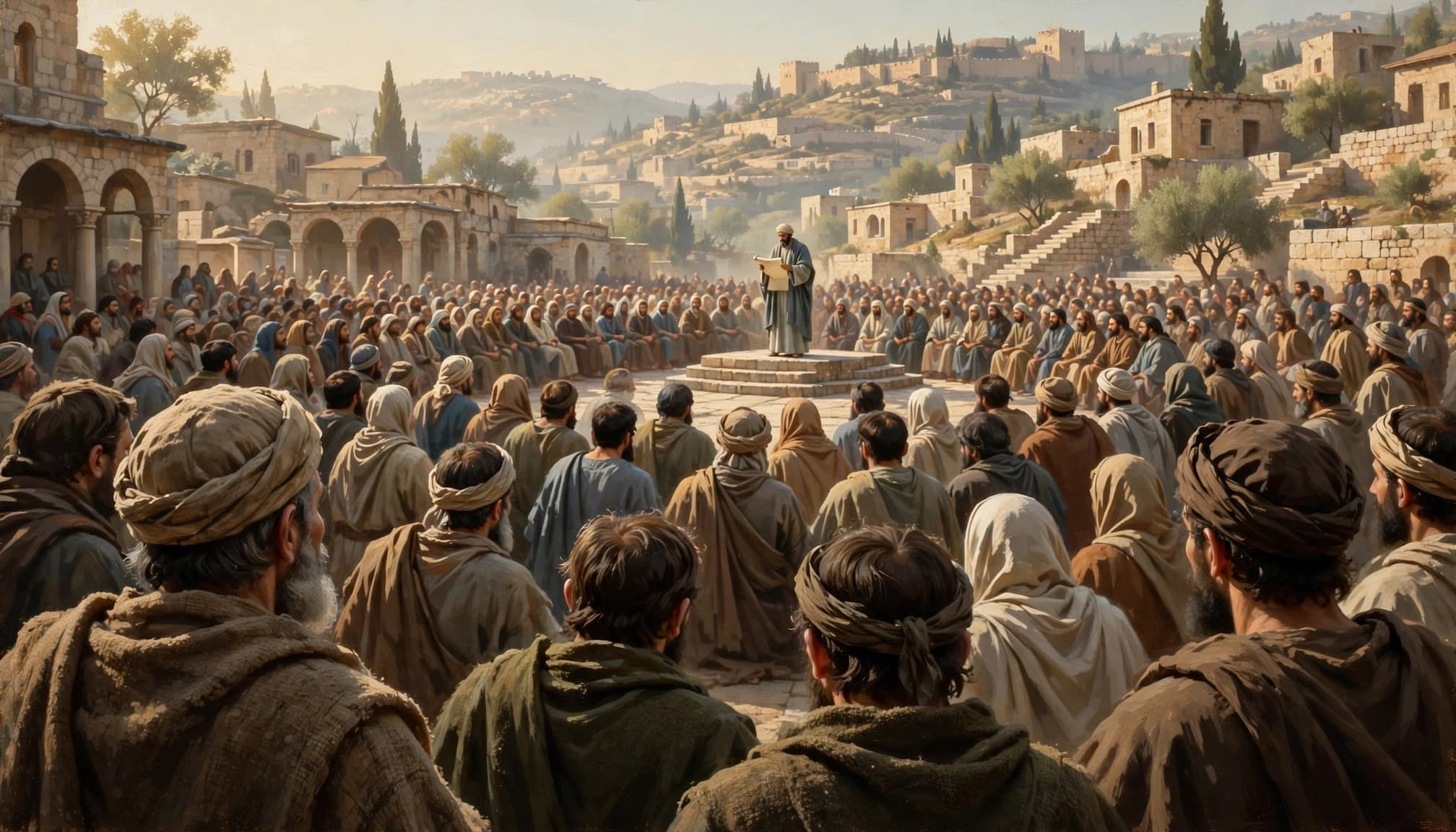
Later, in Nehemiah's account, Ezra publicly read the Law of Moses while the Levites helped the people understand it. Hearing produced conviction, but the leaders also directed the people toward rejoicing in the Lord.
The community celebrated the Feast of Tabernacles for seven days, followed by the appointed assembly on the eighth day. What they learned changed what they practiced.
As Spirit-filled believers, we must receive that instruction seriously. The Holy Spirit never leads us to disregard Scripture. Genuine spiritual response includes understanding, willing obedience, and worship governed by God's Word.
Ezra Confronted Covenant Unfaithfulness
Ezra discovered that members of the returned community, including priests and Levites, had married foreign wives from surrounding peoples whose practices the account connects with covenant unfaithfulness.
The issue concerned loyalty to God and Israel's covenant obligations under the Law of Moses, not race. We must not turn this passage into permission for racial contempt. Scripture's own account includes Ruth, a Moabite woman who entrusted herself to Israel's God.
Ezra responded with grief, prayer, and confession, expressing repentance. The community then undertook a process of separating from the foreign wives and the children born to those unions. This was a severe action with real consequences for families. We shouldn't soften what happened or detach it from Israel's covenant setting.
Neither should we apply it as a command for Christians to divorce unbelieving spouses. Paul's instruction directs a believer to remain when the unbelieving spouse is willing to live together.
The enduring warning concerns tolerated sin after deliverance. Our teaching on Biblical repentance and returning to God follows that connection between confession and changed conduct.
Mercy never makes disobedience harmless.
The Return Was Real, but Restoration Was Unfinished
Rebuilt Structures Couldn’t Change the Heart
The return from exile restored worship at the temple and preserved the community, but it didn't restore an independent Davidic kingdom. Judah remained the Persian province commonly called Yehud, and many Jewish exiles remained outside the land, far from Jerusalem.
BibleProject's account of Ezra and Nehemiah follows the rebuilding alongside the people's continuing failures. The closing scenes show that covenant violations still required confrontation and repentance.
We must distinguish God's faithfulness from the people's faithfulness. His mercy was genuine even when their obedience remained inconsistent.
The Hope Reached Beyond Persia
Some Christian interpretations, including Tabletalk's discussion, describe the return as a partial easing of captivity rather than the complete promised restoration. Persia's rule continued, and bondage to sin remained.
The book doesn't record the glory cloud filling the rebuilt temple, as Scripture describes at the tabernacle and in Solomon's day. That silence doesn't establish that God abandoned His people; Haggai assured them of His presence.
We understand this unfinished picture through the wider Biblical witness. Jesus Christ addresses the sin that rebuilt walls cannot remove. Through His saving work and the Holy Spirit's renewing presence, God's people are called into obedient fellowship with Him.
Frequently Asked Questions
When did Ezra return to Jerusalem?
The traditional chronology places Ezra's return in 458 BC, during the seventh year of Artaxerxes I. Other proposals place his return in 398 BC or around 428 BC, but they haven't displaced the traditional date.
How many people returned with Ezra?
Ezra's group is commonly counted at about 1,754 men, including Levites and temple servants. Women and children also traveled with them, but the account doesn't give a complete population total.
What was Ezra’s role in the return?
Ezra was a priest and scribe who prepared to study the Law of Moses, practice it, and teach it. The temple already stood, so his work focused on God's Word and the community's conduct.
How did Ezra’s return differ from the returns led by Zerubbabel and Nehemiah?
Zerubbabel led the first major return, which included rebuilding the temple. Ezra came later to teach God's Law, while Nehemiah came as governor to rebuild Jerusalem's walls.
Why did Ezra confront marriages to foreign wives?
The account treats the issue as covenant unfaithfulness under the Law of Moses, not race. It doesn't give Christians a command to divorce unbelieving spouses.
God’s Faithfulness Calls for a Faithful Response
Ezra teaches us to recognize God's mercy without separating it from His authority. He brought His people home to Jerusalem, where restoration included renewed worship and confrontation with the sin that threatened covenant faithfulness.
We must receive the same moral instruction without erasing Israel's history. Returning requires surrender.
As you read Ezra, let God's Word examine your loyalties and lead you to repentance. His faithfulness calls for willing obedience to the God Who restores.