
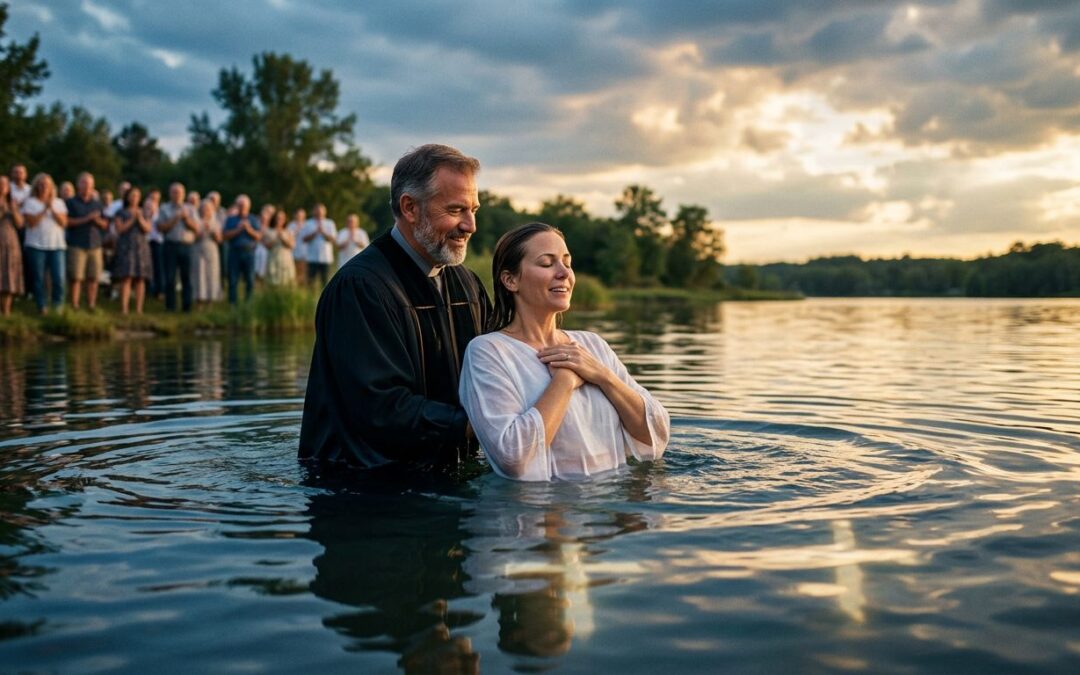
Christian baptism is not an empty religious ceremony; rather, it is the commanded response of a person who has embraced repentance, believed the gospel, and placed their full trust in Jesus Christ. When we enter the water as a public profession of faith, we testify that our old life belongs under the judgment of the cross and that our new life in Christ comes entirely from the risen Lord.
The Bible consistently connects baptism with repentance, faith, obedience, and union with the Savior. Yet, the water itself does not replace faith, and a public ceremony cannot produce a surrendered heart. We must read every passage regarding this ordinance in its proper setting and allow Scripture to lead us into both truth and obedience.
Key Takeaways
- Christian baptism follows the gospel of Jesus Christ, repentance, and faith.
- Baptism pictures our union with Christ in His death, burial, and resurrection.
- The Bible commands baptism, but water cannot replace genuine faith or new birth.
- New life does not end when we leave the water. It continues through obedience, holiness, and fellowship with Christ.
- Christians disagree about infant baptism, the mode of baptism, and its relationship to salvation, so we must look to the early church and historical context to distinguish clear biblical teaching from later traditions.
The Gospel Comes Before Christian Baptism
The gospel comes first. Jesus Christ died for our sins, was buried, and rose again, exactly as Paul summarizes in 1 Corinthians 15:3-4. We are saved by God's grace through faith, not by earning forgiveness through religious works (Ephesians 2:8-9).
That truth does not make baptism unimportant. It makes baptism meaningful. In the Great Commission, Jesus commanded His disciples to make disciples, baptizing them in the name of the Father, Son, and Holy Spirit using the Trinitarian formula, and teaching them to obey His commands (Matthew 28:19-20). Baptism belongs to the obedient life of a disciple.
At Pentecost, Peter preached Christ crucified and risen, offering the forgiveness of sins to all who would believe. When the people were cut to the heart and asked what they should do, Peter instructed them to repent and be baptized in the name of Jesus Christ, a promise of salvation found in Acts 2:38. About three thousand people received his word and were baptized (Acts 2:37-41). The passage joins hearing, repentance, faith, baptism, and continued devotion to the apostles' teaching.
We see the same pattern in the Ethiopian official's conversion. Philip preached Jesus from Isaiah, and when they came to water, the official asked what prevented him from being baptized. After confessing faith in Jesus Christ, he went down into the water and Philip baptized him (Acts 8:26-39). Baptism was not treated as a meaningless addition. It was the public response of a man who had received the message about Christ.
We should not reverse that order. Baptism does not save us because we performed a ceremony. We are baptized because we have heard the gospel and have turned to Jesus. A helpful discussion of this connection is found in why baptism expresses union with Christ.
Baptism Pictures Death, Burial, and Resurrection
Romans 6 gives the clearest explanation of how baptism serves as a powerful symbol of our new life in the Savior. Paul asks whether we should continue in sin because grace has increased. His answer is direct: absolutely not. Those who belong to Christ have died to sin, and water immersion serves as a vivid picture of our union with Jesus in His death, burial, and resurrection.
Paul explains that we were buried with Christ through baptism into death so that, just as Christ was raised from the dead, we also might walk in newness of life, as noted in Romans 6:4. The picture is plain. Going beneath the water represents our death and burial, while coming out of the water signifies resurrection and a new way of living.

Baptism does not mean that our bodies become perfect or that temptation disappears. Romans 6 continues by teaching us to consider ourselves dead to sin and alive to God in Christ Jesus. The water provides a visible confession, but genuine faith must produce a daily surrender to Him.
Colossians 2:12 also connects baptism with being buried and raised with Christ through faith in the working of God. Notice the emphasis. We are raised with Christ through faith in the powerful working of God. The power belongs to God, not the water. The ceremony points us to the finished work of Jesus and the believer's trust in that work.
Galatians 3:27 says that those who were baptized into Christ have put on Christ. This language describes a changed identity. We no longer define ourselves by our old rebellion, our shame, our past, or the approval of others. We belong to Jesus, and our lives must show that we belong to Him.
Christian baptism is therefore more than a private spiritual feeling. It is a public declaration that Jesus is Lord, His cross is sufficient, His resurrection is real, and our old allegiance has been broken.
What Baptism Does, and What It Doesn’t Do
The Bible clearly commands baptism. Jesus received baptism from John the Baptist, not because He had sin to confess, but to fulfill all righteousness (Matthew 3:13-17). Following this, the early church obeyed that command in places like Jerusalem, Samaria, and the home of the Philippian jailer (Acts 2:41; 8:12; 16:30-34).
Baptism is an act of obedience, a public confession of faith, and a visible picture of union with Christ. It tells the church and the watching world that we have turned from the old life and are identifying ourselves with Jesus. It reminds us that discipleship is not merely hidden agreement; Christ calls us to follow Him openly.
At the same time, baptism is not a magical washing that removes sin apart from faith. While some traditions view the act as a sacrament necessary for grace, others view it as an ordinance reflecting a decision already made. Ananias told Saul to be baptized and wash away his sins while calling on the name of the Lord (Acts 22:16). This command is connected to calling on Jesus Christ, not to trusting in water as a power separate from Him.
Peter gives needed clarity in 1 Peter 3:21. He says baptism now saves us, but not as the removal of dirt from the body. Instead, he points to an appeal to God through the resurrection of Jesus. Christians have understood this passage in different ways, but Peter plainly refuses to reduce baptism to an outward bath. The heart's response to God for salvation matters most.
Faith cannot be replaced by baptism, and obedience cannot be dismissed because we claim to have faith. The thief on the cross trusted Christ without the opportunity to be baptized (Luke 23:39-43). In Acts 10, the Holy Spirit fell on Cornelius and his household before Peter commanded them to be baptized. These passages show that God is not trapped by a human order of events.
Christians also differ on how this should be practiced. Some traditions observe infant baptism as a way to address original sin or as a rite of initiation into the covenant community. In these settings, pouring or sprinkling is often used as a mode of administration. Conversely, many believers practice believer's baptism, where only those who personally confess faith are immersed, echoing the immersion performed by John the Baptist. We should speak honestly here instead of treating denominational practice as though every detail is equally explicit in Scripture.
The clearest command is this: those who believe in Christ should receive baptism. A church should teach the significance of the act carefully, examine the confession of faith, and avoid both careless delay and empty ceremony. For a church's explanation of baptism as a beginning of Christian life, see this baptism teaching position.
New Life Continues After We Leave the Water
The greatest mistake is to treat baptism as the finish line. Romans 6:4 reminds us that we are raised to walk in newness of life, signifying a profound spiritual rebirth. While the baptism service lasts only a few minutes, the obedience it pictures must shape every day that follows. We should view the water as an outward symbol of the internal change that has already occurred by grace.
New life means that we belong to Christ and no longer present ourselves as servants of sin. Paul tells us not to let sin reign in our mortal bodies or control our choices (Romans 6:12-14). We still face temptation, but sin is no longer our rightful master. The Holy Spirit provides the power we need to resist, repent, and obey.
Second Corinthians 5:17 states that if anyone is in Christ, he is a new creation. The old has passed away, and the new has come. This does not mean we never remember our past; it means our past no longer has the final word over us. Jesus has given us a new standing, a new direction, and a new Lord.
Ephesians 4:22-24 tells us to put off the old self, be renewed in the spirit of our minds, and put on the new self, created according to God's likeness in righteousness and holiness. New life must become visible in our speech, relationships, private choices, forgiveness, work, and worship.
We do not live this life alone. The baptized believer belongs to the Body of Christ, receiving instruction, prayer, correction, and encouragement. Acts 2:42 says the early believers continued in the apostles' teaching, fellowship, breaking of bread, and prayers. Baptism serves as the beginning of church membership, grounding us in a local community. For practical support after conversion and baptism, we can use this new believers spiritual growth resource and seek faithful fellowship through discipleship small groups.
Baptism identifies us with the Body of Christ, but Christian growth requires continued submission to the Word of God. A person can enter water publicly and still refuse obedience privately. Scripture calls us to more than a moment of testimony. It calls us to a life that bears fruit through the ongoing work of the Holy Spirit.
How We Should Respond to the Biblical Command
If we have trusted Jesus Christ and have never been baptized, we should not treat baptism as an optional religious decoration. Instead, we should bring the matter before a faithful local church, receive biblical instruction, and obey Christ with a willing heart.
If we have already been baptized, we should not depend on the memory of that day while tolerating sin today. We must return to the meaning of our confession, which serves as a sincere dedication to God. Because we died with Christ, we are called to live under His authority, relying on the ongoing guidance of the Holy Spirit to transform our daily walk.
We also must refuse to judge another believer's heart based only on the timing or method of baptism. Scripture gives us a clear command, but Christians have disagreed over several practices. We can hold firmly to biblical truth while speaking with humility where the text has been interpreted differently.
The question is not whether water can impress God. The question is whether we have trusted the Son of God and are willing to follow Him. Baptism is obedience made visible.
Frequently Asked Questions
Is baptism necessary for salvation?
Baptism is an act of obedience for those who have already placed their trust in Jesus Christ, but it does not earn salvation or wash away sin apart from faith. While it is the commanded response of a believer, the Bible emphasizes that salvation is a gift of God’s grace received through faith alone.
Why do some Christians practice infant baptism while others wait?
Christians differ on this practice based on their interpretation of covenant theology and the nature of the church. Some traditions view baptism as a sign of entry into a covenant community, while many others practice believer's baptism, requiring an individual to make a personal confession of faith before being immersed.
What if I was baptized as a child but did not understand the gospel at the time?
Many people who were baptized as children later come to a genuine, personal faith in Jesus Christ as adults. In such cases, many believers choose to be baptized again as a public, conscious profession of their own faith in the gospel, viewing this as a mature step of obedience.
Does the method of baptism matter?
The Bible highlights baptism as a picture of burial and resurrection, which is most clearly illustrated through full immersion in water. While different traditions utilize various modes such as pouring or sprinkling, the focus remains on the believer's identification with the death and resurrection of Jesus Christ.
The New Life Is Found in Christ
Christian baptism points us to the central truth of the gospel: Jesus Christ died, He was buried, He rose again, and those who belong to Him are called to walk in new life. The water cannot save a heart that refuses the Savior, but a believer should not despise the command He gave.
We enter the water confessing that our old life has been judged at the cross. We rise confessing that our future rests in the risen Lord. Then we keep walking, empowered by the Holy Spirit and sustained by grace through faith, in the holiness and obedience that fit those who belong to Jesus.