
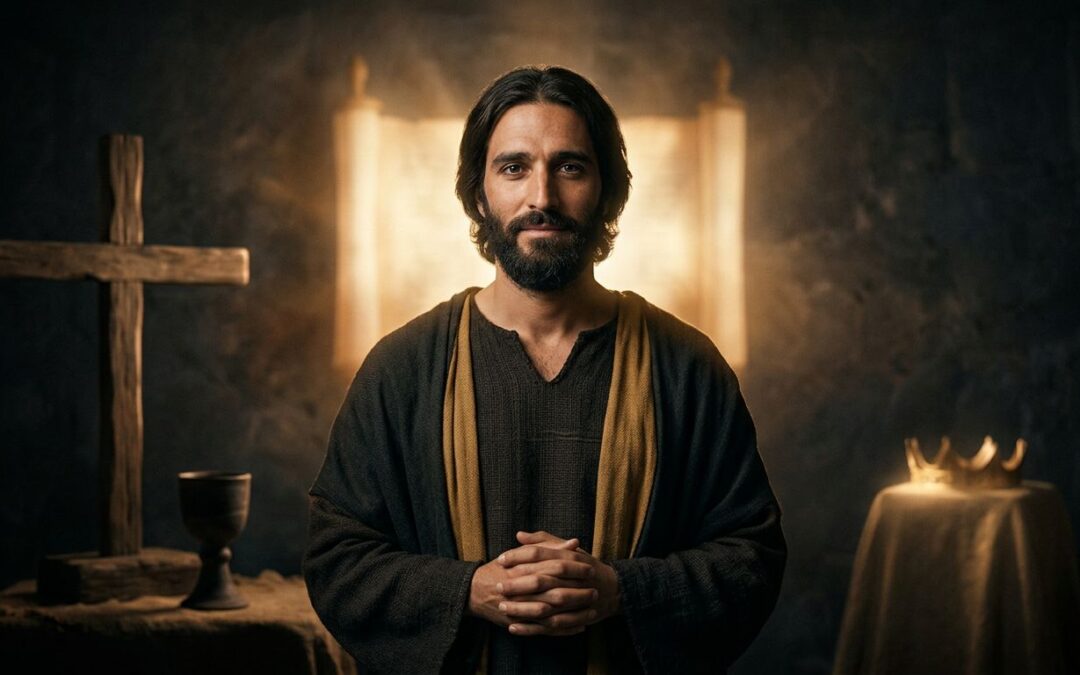
When we confess Christ as Prophet, Priest, and King, we are not repeating three religious titles. We are confessing the complete work of Jesus Christ, the Savior of the world: He reveals God's truth, carries our guilt before the Father, and rules with all authority. Each office answers a real human need, ignorance, sin, and bondage, but all three belong to the one Son of God.
The Bible doesn't present Jesus as a prophet who only teaches, a priest who only dies, or a king who only reigns in the future. His words bring light, His sacrifice brings forgiveness, and His throne demands our obedience. We begin with the biblical pattern behind these offices, then follow it to the cross, the empty tomb, and our daily walk.
Key Takeaways
- Jesus fulfills the threefold office of Prophet, Priest, and King as one complete Savior.
- As Prophet, He reveals the Father, speaks God's truth with authority, and calls us to repentance and obedience.
- As High Priest, Jesus offered Himself once for all, intercedes for His people, and gives full access to God's mercy and grace.
- As the promised Son of David, Jesus reigns as King over His church and all creation, though the full visible triumph of His kingdom is still ahead.
- These offices direct daily life: we listen to Christ in confusion, trust His sacrifice when guilt accuses, and submit to His rule when fear and sin seem powerful.
The Threefold Office Shows One Complete Savior
The phrase threefold office, sometimes called munus triplex, gathers together what Scripture reveals about Christ's mission. Prophet, priest, and king were distinct offices in Israel, though some men held more than one role. Jesus fulfills all three without confusion and without weakness.
He is not three different saviors for three different problems. He is one Savior who reveals God, reconciles sinners, and reigns over all things. The name Christ means "Anointed One," and the Old Testament points forward to the Anointed One who would fulfill every part of God's redemptive purpose.
Scripture gives the pattern
Prophets spoke God's Word to His people. Priests represented the people before God and offered sacrifices for sin. Kings ruled God's people under God's authority. These offices were never ends in themselves. They pointed forward to Jesus, because no human prophet, priest, or king could complete the work.
Hebrews 1:1-3 brings these truths together. God spoke through the prophets, but He has spoken finally through His Son. The Son made purification for sins, then sat down at the right hand of God's majesty. Revelation, sacrifice, and enthronement belong together in Jesus Christ.
The historical name came later
The Bible supplies the truth, even though the theological framework developed later. John Calvin gave the framework a lasting shape in the sixteenth century, but he wasn't inventing a doctrine apart from Scripture. He was organizing the Bible's teaching about Christ's work. This historical overview of Christ's threefold office explains how the term munus triplex developed in Christian theology.
We should never let the label replace the Lord Himself. The point isn't to memorize three categories. The point is to know Jesus as He is revealed in Scripture.
Jesus Prophet Priest King Reveals God
A prophet is not merely a person who predicts future events. A prophet receives and declares God's message. Jesus is the final and perfect Prophet, and in His prophetic office He doesn't merely deliver a message from God. He is the Word of God who reveals the Father.
The Prophet promised by Moses
In Deuteronomy 18, Moses spoke to Israel before they entered the promised land. The people had been terrified by God's voice at Mount Sinai, so God promised to raise up a prophet like Moses. Israel was commanded to listen to him.
Peter applied that promise directly to Jesus in Acts 3. After healing a man at the temple, Peter called Israel to repentance and identified Jesus as the Prophet Moses had announced. You can read Moses' promise and Peter's interpretation together.
Jesus is greater than Moses. Moses received God's Word and delivered it faithfully. Jesus speaks with His own authority because He is the Son who came from the Father. John 1:18 says that the Son has made the Father known. Jesus could say, "Whoever has seen me has seen the Father" (John 14:9).
His Word demands a response
Jesus taught the truth about God's holiness, the seriousness of sin, the nature of the Kingdom of God, and the need for repentance. He didn't soften God's commands to gain approval. He didn't treat truth as a suggestion.
When Jesus forgave the paralyzed man's sins in Mark 2, the scribes understood the claim He was making. Only God can forgive sins. Jesus then healed the man to show that the Son of Man had authority on earth to forgive sins. His prophetic ministry revealed God's will, and His divine authority confirmed His message.
Jesus also foretold His death, resurrection, the coming of the Holy Spirit, the destruction of Jerusalem, and His future return. We don't need to chase voices that compete with Christ's Word. We need to hear what He has already spoken and obey it.
Jesus doesn't merely inform us about God. He calls us to repentance, faith, and obedience before God.
Jesus the High Priest Offers Himself
The priestly office answers the problem of guilt. A prophet tells us what God says, but a priest deals with the sinner's separation from God. Jesus is the ultimate High Priest. He offered Himself as the spotless sacrifice and now intercedes for His people, giving them eternal life.
He is better than Aaron
The priests descended from Aaron served in the tabernacle and temple under the Aaronic Priesthood. This Levitical priesthood offered sacrifices for the people's sins, but those sacrifices had to be repeated. The priests themselves were sinners, so they needed sacrifices for their own guilt.
Jesus was sinless. He didn't offer an animal in our place while remaining outside the cost of redemption. He offered His own body and blood. The Book of Hebrews explains in chapter 7 that the former priests were many because death prevented them from continuing. Jesus holds His priesthood forever and saves completely those who draw near to God through Him.
Hebrews 4:14-16 was written to believers who needed endurance. Because Jesus has passed through the heavens as the great High Priest, they were told to hold firmly to their confession and approach God's throne for mercy and grace. Read the passage alongside Hebrews' teaching on Jesus as High Priest.
Jesus understands human weakness because He was tempted in every way as we are, yet He remained without sin. He is not a distant priest who has no compassion. He is the holy Son of God who knows our weakness and still has power to save.
The order of Melchizedek matters
Genesis 14 introduces Melchizedek as both king of Salem and priest of God Most High. He blessed Abraham, and Abraham gave him a tenth of the spoils. Psalm 110 later declares that the promised Messiah is a priest forever according to the order of Melchizedek.
Hebrews uses this passage to explain why Jesus' priesthood is greater than the Levitical priesthood. Jesus wasn't a priest because He descended from Aaron. He was appointed by God's oath, and His priesthood cannot end because His life cannot end. The order of Melchizedek points to a priesthood joined to righteousness, peace, kingship, and permanence.
The sacrifice was once for all
On the Day of Atonement, Israel's appointed priest entered the Most Holy Place with sacrificial blood. That ceremony was repeated because animal blood could not finally remove sin. It pointed forward to a better sacrifice.
Jesus entered the heavenly sanctuary by His own blood. Hebrews 9 says He offered Himself once for all to secure eternal redemption. The cross wasn't an accident or merely an example of love. Christ's sacrificial death was God's provision for sinners and secured eternal salvation.
Because Jesus is our living High Priest, His priestly work didn't end at the resurrection. Romans 8:34 says He is at the right hand of God and intercedes for us. We don't approach God based on our performance. We approach through Jesus, the mediator between God and sinners, whose sacrifice is sufficient and whose intercession never fails.
Jesus the Son of David Rules
The kingly office answers the problem of bondage. We aren't only ignorant and guilty. We are also enslaved by sin, death, fear, and powers that oppose God. Jesus is the promised Son of David, the promised Messiah, and the rightful King whose authority cannot be overturned.
His kingdom is not an earthly imitation
God promised David that his throne and kingdom would endure (2 Samuel 7:12-16). The angel Gabriel declared that Jesus would receive the throne of His father David and reign over the house of Jacob forever (Luke 1:32-33).
As the Son of David, Jesus fulfills God's covenant promise. His kingship is unlike the rule of earthly politicians. When Pilate questioned Him, Jesus said His kingdom was not from this world (John 18:36-37). He wasn't saying that His authority had no connection to this world. He was saying that His kingdom doesn't come from human systems, military force, or political power.
Jesus rules with truth and righteousness. Earthly kings protect their position. Jesus laid down His life for His people. Earthly rulers die and are replaced. Jesus reigns forever.
The cross became His throne
The soldiers mocked Jesus as "King of the Jews," placed a crown of thorns on His head, and attached a charge above the cross. Their mockery declared more truth than they understood. Jesus was truly the King, and His path to the throne went through suffering and death.
After the resurrection, Peter preached that God had raised Jesus and exalted Him at His right hand. Jesus then declared, "All authority in heaven and on earth has been given to me" (Matthew 28:18). His reign is present now. He rules His church, sends His Spirit, answers prayer, and subdues His enemies.
The full visible triumph of His kingdom is still ahead. First Corinthians 15:25-26 says He must reign until every enemy is put under His feet, with death as the final enemy. We don't wait to decide whether Jesus is King. He is King now, and every person will answer to Him.
How Christ’s Offices Direct Daily Life
The doctrine of Jesus Prophet Priest King reaches far beyond theology. These offices show us where to turn when confusion, guilt, fear, and temptation press against us.
When confusion rules
We listen to Jesus as Prophet. His teaching corrects our thinking when public opinion, personal feelings, and false teachers pull us in different directions. We don't build our faith on impressions that contradict Scripture. We return to what He has spoken.
His prophetic work shapes our homes, work, decisions, and conversations. We speak truth because our Prophet is true. We repent when His teaching exposes sin. We trust His commands even when obedience costs us something.
When guilt accuses
We come to Jesus as Priest. We don't hide our sin, excuse it, or try to pay for it through religious effort. We confess it and trust the sufficient sacrifice Christ offered for us.
A guilty conscience often tells us to run from God. The gospel tells us to run to God through Jesus. His sacrifice is sufficient, His intercession is certain, and His mercy doesn't depend on our strength.
When fear and sin seem powerful
We submit to Jesus as King. His authority is greater than sin, Satan, death, or any earthly ruler. We don't fight spiritual battles through self-confidence. We stand under the authority of the risen King and obey Him.
Our calling is not to take Christ's offices for ourselves. We don't become saviors or kings over other people. We bear witness to the Prophet, depend on the Priest, and serve the King. In our vocation, we tell the truth, pray for others, resist sin, and honor Jesus above every competing authority.
Frequently Asked Questions
What does it mean that Jesus is Prophet, Priest, and King?
It means that Jesus fulfills three essential offices in God's redemptive plan. He reveals God's truth as Prophet, deals with our guilt as Priest, and rules with all authority as King.
How is Jesus greater than the Old Testament prophets and priests?
The prophets delivered God's Word, but Jesus is the Son who perfectly reveals the Father. The priests offered repeated sacrifices for sin, but Jesus offered Himself once for all and continues forever as the living High Priest.
Is Jesus reigning as King now?
Yes, Jesus was raised and exalted to the Father's right hand, and all authority in heaven and on earth has been given to Him. The full visible triumph of His kingdom is still ahead, when every enemy, including death, will be put under His feet.
How should Christ’s three offices shape daily life?
We listen to Jesus as Prophet when confusion or false teaching confronts us, and we trust Him as Priest when guilt accuses us. We submit to Him as King by resisting sin, obeying His Word, and honoring His authority above every competing power.
One Savior, One Lord
Jesus is the Prophet who reveals the Father, the High Priest who offered Himself for sin, and the King who reigns with all authority. These offices remain distinct, yet they must never be separated. His teaching leads us to His cross, His sacrifice places us under His reign, and His reign calls us to obey His Word.
When anxiety rises, listen to His truth. When guilt accuses, trust His sacrifice. When fear demands control, bow before His throne. Jesus Christ is not only the Savior we need. He is the Lord we must follow.