
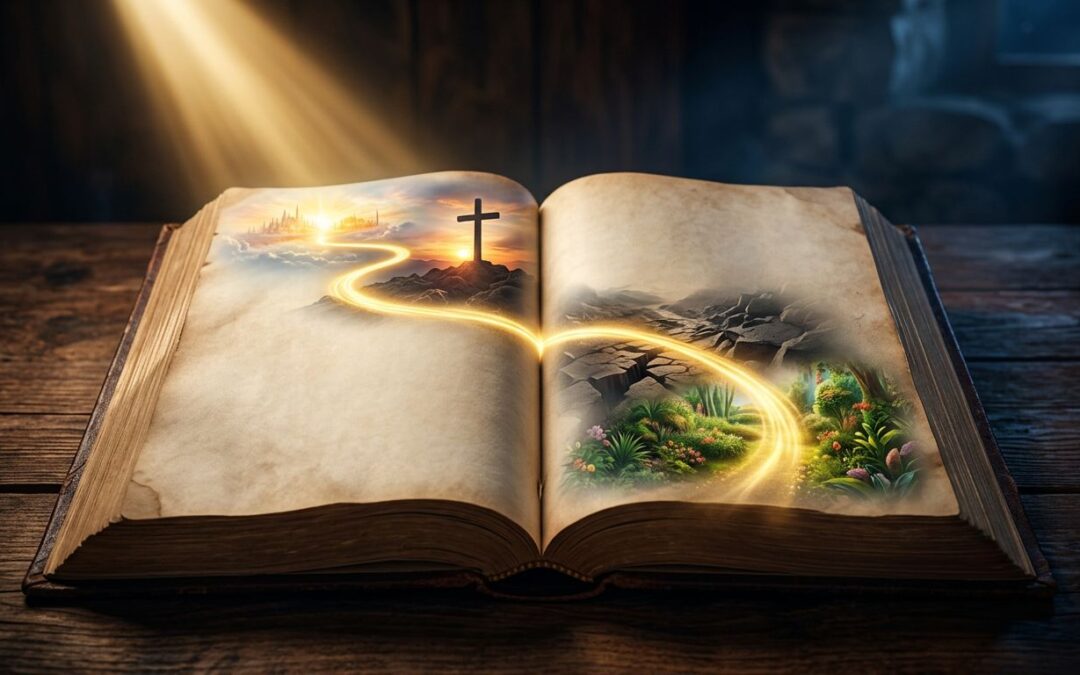
A single Bible verse can encourage, correct, or answer you. Yet to trace biblical themes is to see how that verse belongs to Scripture's unified metanarrative of Scripture. Its big story follows the creation fall redemption arc, with Jesus Christ at the center and the new creation as its promised completion.
When we collect isolated verses, we can make the Bible say almost anything. Following the theme through context and historical setting shows its place in redemptive history, correcting our assumptions and clarifying God's truth. We begin with this unified story, then follow the theme carefully.
Key Takeaways
- To trace biblical themes is to follow how a truth develops across Scripture's unified creation, fall, redemption, and new creation story.
- A biblical theme is more than a repeated word; it may appear through ideas, events, images, people, institutions, promises, and patterns.
- Careful study requires defining the theme, reading passages in context, following its development book by book, and testing conclusions against clearer Scripture.
- Biblical theology follows a theme through redemptive history, while systematic theology gathers the Bible's teaching into a faithful doctrinal summary.
- The Bible's themes reach their fulfillment in Jesus Christ and point toward God's complete presence with his redeemed people in the new creation.
Begin With the Bible’s Unified Story
The Bible has many books, authors, genres, and historical settings, but it tells one unified story. This big story is the biblical narrative.
It begins with creation, humanity as the image of God, and the tree of life, followed by the fall. It then moves through covenant promises, the promised land, the promised deliverer, and the kingdom of God. The story reaches its center in Jesus' death and resurrection and looks ahead to final restoration.
A biblical theme gains meaning as it develops across that story and through redemptive history.
A biblical theme is more than a repeated word
Each biblical theme may emerge through ideas, events, images, or promises. It develops across several passages, and the word itself may not appear every time.
For example, the theme of God's presence includes the garden of Eden, the tabernacle, the temple, the incarnation of Jesus, the indwelling Holy Spirit, and God's presence in the New Jerusalem. If we search only for the word "presence," we will miss much of the theme.
The same is true for light, water, shepherding, sacrifice, wilderness, kingdom, and holiness. These themes appear through words, events, people, institutions, and promises.
The Bible’s story gives themes their meaning
We must not treat a theme as a collection of attractive connections. Scripture gives each theme a direction.
Light begins with creation in Genesis 1:3. Across Scripture, it becomes associated with God's glory and salvation, points to Jesus in John 8:12, and reaches completion in the city described in Revelation 21:23. Water likewise moves from creation and judgment to Israel's deliverance and cleansing. Jesus uses it in his teaching, and Revelation 22:1 presents the river of life.
These passages are not identical, and we must not force them into one meaning. Yet they belong to a developing biblical pattern. The biblical theology definition from Grace Seminary describes this kind of study as following God's revelation through Scripture's redemptive story.
Biblical Theology Follows the Story
Biblical theology and systematic theology are related, but they ask different questions about a biblical theme.
Biblical theology follows development
This approach asks how a truth develops within the Bible's own storyline. It considers what Moses wrote and what the prophets announced. The New Testament presents fulfillment through Jesus, and the apostles explain Christ's work. Together, these biblical authors develop the canon's witness.
This approach pays attention to time, covenant, promise, and fulfillment in redemptive history. The Old Testament begins this movement within its original setting. It asks where a theme begins, how it develops, and where God brings it.
Reading Scripture book by book uses a storyline approach. It keeps the biblical narrative and the kingdom of God in view, rather than flattening every passage into a list.
Systematic theology gathers the Bible’s teaching
Systematic theology gathers everything Scripture teaches about a doctrine, such as salvation, the church, or sin. It organizes those teachings into a clear and faithful summary.
We need both approaches. The storyline protects us from ignoring the Bible's development. Systematic theology helps us summarize what the entire Bible teaches. The story comes first, but the doctrinal summary must agree with it.
The Old Testament is not a collection of religious ideas detached from the rest of Scripture. It contains promises, patterns, sacrifices, offices, and shadows that find fulfillment in Jesus Christ, while retaining the meaning they had for their original hearers.
How to Trace Biblical Themes Without Proof-Texting
A repeatable process keeps our study grounded. This biblical theology method follows a storyline approach. We can use it with a major theme or a smaller theme within one book.
1. Define the theme before searching
State the biblical theme in one clear sentence. "God dwells with his people" is more useful than simply writing "temple." "God provides a faithful shepherd for his people" is more precise than searching every use of the word "shepherd."
Write down related terms, images, and actions. For the temple theme, these may include dwelling, glory, priest, sacrifice, holiness, sanctuary, house, presence, and access.
This first definition matters because a theme can become so broad that every passage appears to support it. A narrow statement gives the study boundaries.
2. Find the beginning, turning points, and completion
Read the passages book by book in canonical order. Begin with the earliest clear appearance, then identify major developments, conflicts, promises, and fulfillments.
Ask these questions:
- Where does this theme first appear?
- What problem affects or interrupts it?
- What promise advances it?
- Does the theme become clearer in the prophets?
- How does Jesus fulfill, correct, or intensify it?
- How do the apostles apply it?
- Where does Scripture bring it to completion?
Don't begin with a favorite verse and work backward until the Bible agrees with you. Begin where the theme begins.
3. Read every passage in context
Read the whole paragraph, chapter, and book when necessary. Consider the biblical authors' purpose, the original audience, the historical setting, and the genre.
A command in the Law, a proverb, a vision in a prophet, a parable, and an instruction in an epistle must not be interpreted in precisely the same way. Poetry uses imagery, narrative reports events, and prophecy may combine immediate and future fulfillment.
Compare translations carefully as well. A Hebrew or Greek word may be translated by different English words. The same English word may translate several original words. The searchable Bible at BibleGateway can help you compare passages across multiple translations, but the surrounding context must govern your conclusion.
4. Test the conclusion against clearer Scripture
A proposed connection isn't true simply because it sounds meaningful. Use cross references to verify it, but don't let them replace careful interpretation.
Let clear passages illuminate less-clear passages, not the other way around.
Look for direct quotations, explanations, and applications in the New Testament. Pay attention to how Jesus and the apostles read earlier Scripture, including its promises and fulfillment. Jesus taught that the Scriptures testified about him (John 5:39), and after his resurrection he explained the things concerning himself in Moses, the Prophets, and the Psalms (Luke 24:27, 44-47).
This doesn't mean every detail in the Old Testament is a secret code. It means the Bible must be read according to the way its divine Author and human authors present its unity.
Use Cross References as Servants
Cross references are useful, but context remains the final judge. They give us possible connections that we must examine.
A printed study Bible, a concordance, and an online search can uncover passages we might miss. The Bible Study Tools concordances are useful for locating repeated words and related entries.
Search words first, then search concepts. If you are tracing the theme of shepherding, look beyond “shepherd” to flock, pasture, rod, staff, ruler, guide, and false shepherds. For sacrifice and atonement, search for offerings, blood, altar, priest, lamb, and once-for-all sacrifice.
A cross-reference can show where a phrase appears, but only context can show what it means.
Write your findings in a simple chart with four columns: reference, context, development, and connection to Christ. This keeps the study from becoming a pile of verses with no explanation.
A Worked Example: The Temple Theme
This biblical theme shows how the biblical narrative develops God's presence, offering a biblical theology reading rather than merely collecting temple references.
Begin with God’s presence
Genesis does not explicitly call Eden a temple. Still, the garden is a place where God is present with humanity, where Adam is placed to work and keep it (Genesis 2:15), and where cherubim guard the way after the fall (Genesis 3:24). Many readers see temple-like patterns here, but we should call them patterns rather than claim that Genesis uses the word temple.
The tabernacle makes God's purpose unmistakable. God tells Israel, "Let them make me a sanctuary, that I may dwell in their midst" (Exodus 25:8). His glory fills the tabernacle (Exodus 40:34-38), and later fills Solomon's temple (1 Kings 8:10-13).
The theme concerns more than a building. It is about a holy God dwelling among a sinful people through covenant, cleansing, priesthood, sacrifice and atonement. These provisions grant access to his presence.
Follow the theme toward Jesus
The Old Testament prophets expose Israel's unfaithfulness and look toward restored fellowship with God. Ezekiel 47 describes life-giving water flowing from the temple, while the prophets also promise that God will cleanse and restore his people.
Jesus Christ brings the temple theme to its fulfillment in his own person. In John 2:19-21, he speaks of the temple of his body. He is greater than the temple (Matthew 12:6), because God's presence is not merely near him. The fullness of God dwells in him (Colossians 2:9).
The church is called God's temple because the Holy Spirit dwells among God's people (1 Corinthians 3:16-17; Ephesians 2:21-22). Individual believers are also called temples of the Holy Spirit (1 Corinthians 6:19). These passages don't make the church a replacement for Christ. They show that Christ shares his life and Spirit with those who belong to him.
Finish with the new creation
Revelation 21:22 says that John saw no temple in the New Jerusalem, "for its temple is the Lord God the Almighty and the Lamb." Revelation 22:2 adds the river of the water of life and the tree of life, showing the temple's completion. The theme reaches its end where it was always going: God fully present with his redeemed people.
A building is no longer needed because access to God is complete. The temple theme begins with God's presence lost through sin. It ends with God's presence enjoyed forever through the Lamb, where his people receive eternal life.
For another visual study of the Bible's heaven-and-earth theme, see BibleProject's Heaven and Earth theme. Use such resources as aids, not as substitutes for reading Scripture itself.
Common Mistakes That Distort Biblical Themes
Collecting isolated verses
A verse removed from its paragraph can appear to support a conclusion its author never intended. Read the passage in context, then compare it with the rest of the book before connecting it to another text.
Flattening every passage
The Bible's unity doesn't erase its diversity. A promise to Israel, a warning to a church, and a proverb about wisdom may have different immediate applications. Honor those differences while asking how each passage belongs to the whole canon.
Forcing symbolism into every detail
Not every object, number, location, or repeated word carries a hidden meaning. The safest connections are those Scripture itself makes, especially through direct quotation or clear explanation.
Ignoring negative developments
A theme may include failure before fulfillment. Israel's shepherds are condemned in Ezekiel 34, but Jesus calls himself the good shepherd in John 10:11. Their failure makes his contrast meaningful. Don't turn every occurrence into a positive example.
Our conclusions must also account for historical setting, genre, translation differences, and the difference between what a passage clearly says and what faithful readers infer.
A Concise Scripture-Tracing Checklist
Before accepting your conclusion, test it with this storyline approach:
- Have I defined the theme in one clear sentence?
- Have I read each passage in its immediate context?
- Have I considered genre, author, audience, and historical setting?
- Have I searched related concepts, not only one English word?
- Have I followed the theme book by book where appropriate?
- Have I compared translations where wording matters?
- Have I let clearer passages guide less-clear ones?
- Have I shown how the theme relates to Jesus without forcing a connection?
- Have I distinguished biblical teaching from my own inference?
Frequently Asked Questions
What does it mean to trace a biblical theme?
To trace a biblical theme means to follow an idea, pattern, promise, or image across Scripture. The goal is to see how it develops within the Bible's unified story and reaches fulfillment in Jesus Christ and the new creation.
How is biblical theology different from systematic theology?
Biblical theology asks how a truth develops through the Bible's storyline, covenants, promises, and fulfillment. Systematic theology gathers Scripture's teaching on a doctrine and organizes it into a clear summary; both approaches are necessary.
How can I trace a theme without proof-texting?
Begin by defining the theme, finding its earliest clear appearance, and reading each passage in its historical and literary context. Then compare related passages and test your conclusion against clearer Scripture rather than collecting isolated verses.
Do biblical themes always depend on repeated words?
No. A theme may develop through events, images, people, institutions, and promises even when the same word does not appear in every passage. The theme of God's presence, for example, includes Eden, the tabernacle, the temple, Christ, the Holy Spirit, and the New Jerusalem.
How do biblical themes point to Jesus?
Themes point to Jesus when Scripture presents him as their fulfillment, climax, or greater reality. The temple theme, for example, moves from God's dwelling among Israel to God's presence in Christ, his church, and the completed new creation.
Conclusion
Reading themes across Scripture means hearing one testimony, not collecting disconnected verses. The Bible’s creation fall redemption arc moves through covenant promise, judgment, and restoration. We honor each passage’s context and purpose.
Its themes don’t lead us into speculation; they lead us to the God who speaks, saves, dwells with his people, and fulfills his promises. Revelation’s tree of life points to restored access to God, eternal life, and the hope of the new creation. Read carefully, follow faithfully, and let the whole counsel of Scripture shape what you believe.